


Working with a personal injury lawyer who prioritizes genuine client relationships over case volume can make the difference between a rushed settlement and full compensation.
Credentials, courtroom experience, and direct accessibility matter when selecting an experienced personal injury attorney after an accident.
Admission to the practice of law in Georgia is overseen by the Board to Determine Fitness of Bar Applicants and the Board of Bar Examiners, ensuring attorneys meet rigorous professional standards.
When your physical recovery and financial stability are at stake, you need a dedicated attorney whose qualifications align with your needs.
Verifying attorney credentials and educational background serves as the foundation for selecting qualified legal representation.
Before entrusting someone with your claim, confirm their training meets Georgia’s professional requirements.
Foundational credential markers worth verifying are:
These credentials translate directly to effective advocacy.
An attorney with proper training, court admission, and professional recognition brings the knowledge and standing needed to challenge big insurance companies and pursue fair compensation.
Personalized legal service allows attorneys to develop strategies tailored to your specific circumstances rather than applying generic approaches.
When your lawyer maintains a limited caseload and prioritizes direct communication, you receive the focused attention your case deserves.
Distinguishing features of client-centered service involve:
This individualized attention improves case outcomes and helps secure a fair settlement by allowing your attorney to identify details that high-volume firms might overlook.
Insurance companies often take advantage of injured victims by offering quick settlements that don’t account for the full scope of injuries, but an attorney focused on your specific needs can recognize and counter these tactics.
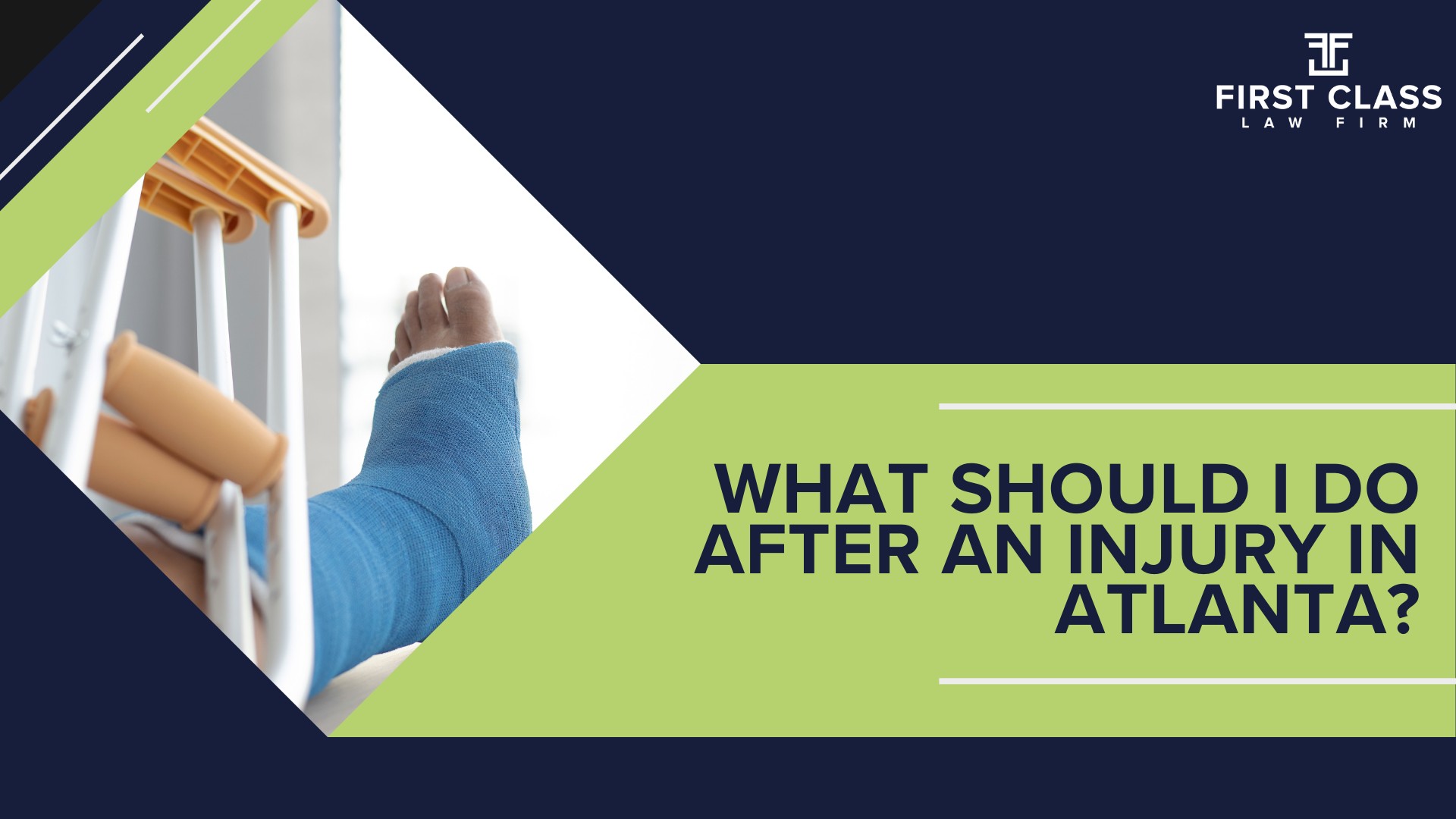
Taking the right steps immediately after an accident protects both your health and your legal rights.
The actions you take in the hours and days following an injury can affect your ability to secure fair compensation.
Georgia’s crash reporting requirements mandate specific procedures for vehicle accidents, and similar documentation principles apply to other injury incidents.
Knowing what to do after a serious accident when you’re hurt, confused, and potentially in pain helps preserve the evidence needed to build a strong claim.
Your immediate actions at the scene and in the following hours can shape the outcome of your claim.
These steps help establish what happened, document injuries, and protect your legal interests.
Time-sensitive post-accident priorities to address are:
These actions create a foundation for your claim while you’re still at the scene.
Missing any of these steps can complicate your case later, so treat each one as important even when you’re dealing with pain and stress.
Medical records establish the severity of your injuries and directly link them to the accident.
Insurance companies scrutinize medical documentation during the claims process, and gaps or inconsistencies can be used to reduce or deny compensation.
Comprehensive medical documentation serves multiple purposes in your claim.
Your initial visit to medical providers creates a record showing you sought treatment immediately after the accident, which helps establish causation.
Detailed records from medical professionals, including diagnostic tests and treatment plans, demonstrate the extent of your injuries and justify the compensation you’re seeking.
Following all medical treatment recommendations and attending every scheduled appointment shows you’re taking your recovery seriously, while gaps in treatment allow insurance adjusters to argue your injuries weren’t severe enough to warrant ongoing care.
Consulting an attorney before providing statements to insurance companies helps you avoid saying something that could harm your claim, and early legal representation ensures all deadlines are met while evidence is still fresh.
If you or a loved one has been injured in an accident, you may be eligible to seek compensation.
Contact First Class — The Atlanta Personal Injury Law Firm using the chat on this page to receive guidance on documenting your injuries and protecting your right to compensation.
Georgia law allows accident victims to seek compensation for a wide range of incidents caused by someone else’s negligence or wrongful actions, from vehicle collisions to nursing home negligence.
Whether your injuries resulted from a vehicle collision, unsafe property conditions, or defective products, you may have grounds for a claim if another party’s careless or reckless behavior caused your harm.
Georgia’s traffic records data tracks thousands of injury-causing incidents annually, while premises liability and product defect cases add to the scope of actionable claims.
Knowing which category your situation falls into helps you move forward with the right legal approach.
Vehicle accidents represent one of the most common sources of personal injury claims in Georgia.
When another driver’s negligence causes a collision, injured parties can pursue compensation for their losses with a car accident lawyer.
The National Highway Traffic Safety Administration’s Fatality Analysis Reporting System (FARS) provides nationwide crash data documenting traffic fatalities and injuries across all states, including Georgia.
Common vehicle accident claim categories encompass:
Georgia’s traffic records systems document these incidents to support injury claims and identify dangerous conditions.
Vehicle accident cases often involve intricate liability analysis of all parties involved, particularly when multiple entities share fault or when commercial businesses bear responsibility for driver actions.
Personal injury claims extend beyond vehicle accidents to encompass many situations where property owners, businesses, or individuals fail to exercise reasonable care.
These cases often involve hazardous conditions or dangerous actions that cause preventable harm.
Non-vehicle injury cases include premises liability claims where property owners breach their duty to maintain safe conditions, resulting in slip and fall accidents, inadequate security leading to assaults, dog bite injuries, swimming pool accidents, or injuries from falling objects or structural failures.
Medical malpractice claims arise when healthcare providers deviate from accepted standards of care through surgical errors, misdiagnosis, medication mistakes, or birth injuries.
It’s important to be aware of the Georgia statute of limitations that may apply to such claims.
Product liability cases involve defective consumer products, dangerous pharmaceuticals, faulty medical devices, or unsafe children’s products.
These cases require thorough investigation to establish how the defendant’s negligence directly caused your injuries.
When negligence or wrongful conduct causes a person’s death, Georgia law allows certain family members to seek compensation for their loss.
O.C.G.A. § 51-4-2 establishes who can file these claims and what damages they may recover.
A wrongful death case may arise from fatal vehicle accidents, medical negligence resulting in death, workplace accidents causing fatalities, premises liability incidents with fatal outcomes, or defective products leading to death.
The deceased person’s spouse, children, or parents typically have the right to file these claims and seek compensation for the full value of the deceased person’s life, including both economic losses and the intangible value of their life to survivors.
If you or a loved one has been affected by a serious injury or wrongful death, you may be eligible to seek compensation.
Contact First Class — The Atlanta Personal Injury Law Firm using the chat on this page to determine whether your situation qualifies for a personal injury claim in Atlanta under Georgia law.
Georgia operates as an at-fault state for personal injury cases, meaning the party who caused an accident bears financial responsibility for resulting injuries and damages.
This system differs from no-fault states where each party’s insurance covers their own losses regardless of who caused the incident.
Georgia’s auto insurance requirements reflect this fault-based approach, establishing minimum liability coverage drivers must carry to compensate others they injure.
The fault system directly affects how you pursue compensation, what evidence you need to prove your claim, and how shared responsibility impacts your recovery.
In Georgia’s at-fault system, the responsible party who caused an accident must compensate injured individuals for their losses.
This means you can file a claim directly with the at-fault party’s insurance company or pursue a personal injury lawsuit if the insurance settlement doesn’t adequately cover your damages.
The at-fault system places the burden on injury victims to prove another party’s negligence caused their harm.
You must demonstrate that the defendant owed you a duty of care, breached that duty through careless or reckless actions, and directly caused injuries that resulted in measurable damages.
Georgia’s insurance regulations require drivers to maintain liability coverage specifically to pay for injuries they cause, but these minimum requirements often fall short of fully compensating seriously injured victims.
When the at-fault party lacks sufficient insurance or disputes their responsibility, pursuing compensation becomes more challenging and typically requires legal representation to protect your interests.
Georgia’s modified comparative negligence law allows injury victims to recover financial compensation even when they share some responsibility for an accident.
O.C.G.A. § 51-12-33 establishes the specific requirements and limitations of this rule.
Under this statute, you can recover damages as long as you bear less than 50% of the fault for the accident.
If you’re found 49% responsible or less, you can still pursue compensation, but your recovery will be reduced by your percentage of fault.
For example, if you suffer $100,000 in damages but a jury determines you were 30% at fault, your compensation would be reduced to $70,000.
However, if you’re found 50% or more responsible, you’re barred from recovering any compensation regardless of how severe your injuries are.
Insurance companies often try to shift blame onto injury victims to reduce their payout obligations or deny claims entirely.
They may argue you were speeding, distracted, or violated traffic laws to increase your fault percentage.
Contact First Class using the chat on this page to receive guidance on protecting yourself from unfair fault allocation and ensuring your percentage of responsibility is accurately assessed based on the evidence.
Georgia law allows injury victims to pursue multiple categories of compensation depending on the severity of their injuries and the accident circumstances.
Your damages may include both quantifiable financial losses and more subjective harms like physical pain and emotional trauma.
The CDC reports that motor vehicle crash deaths in 2022 resulted in over $470 billion in total costs (including medical costs and cost estimates for lives lost) demonstrating the substantial economic burden these incidents place on victims and families dealing with loss.
Knowing what types of compensation you can seek helps you assess whether a settlement offer adequately addresses your losses.
Economic damages represent your quantifiable financial losses resulting from the accident.
These damages come with documentation like medical bills, pay stubs, and repair estimates that establish the exact dollar amount of your harm.
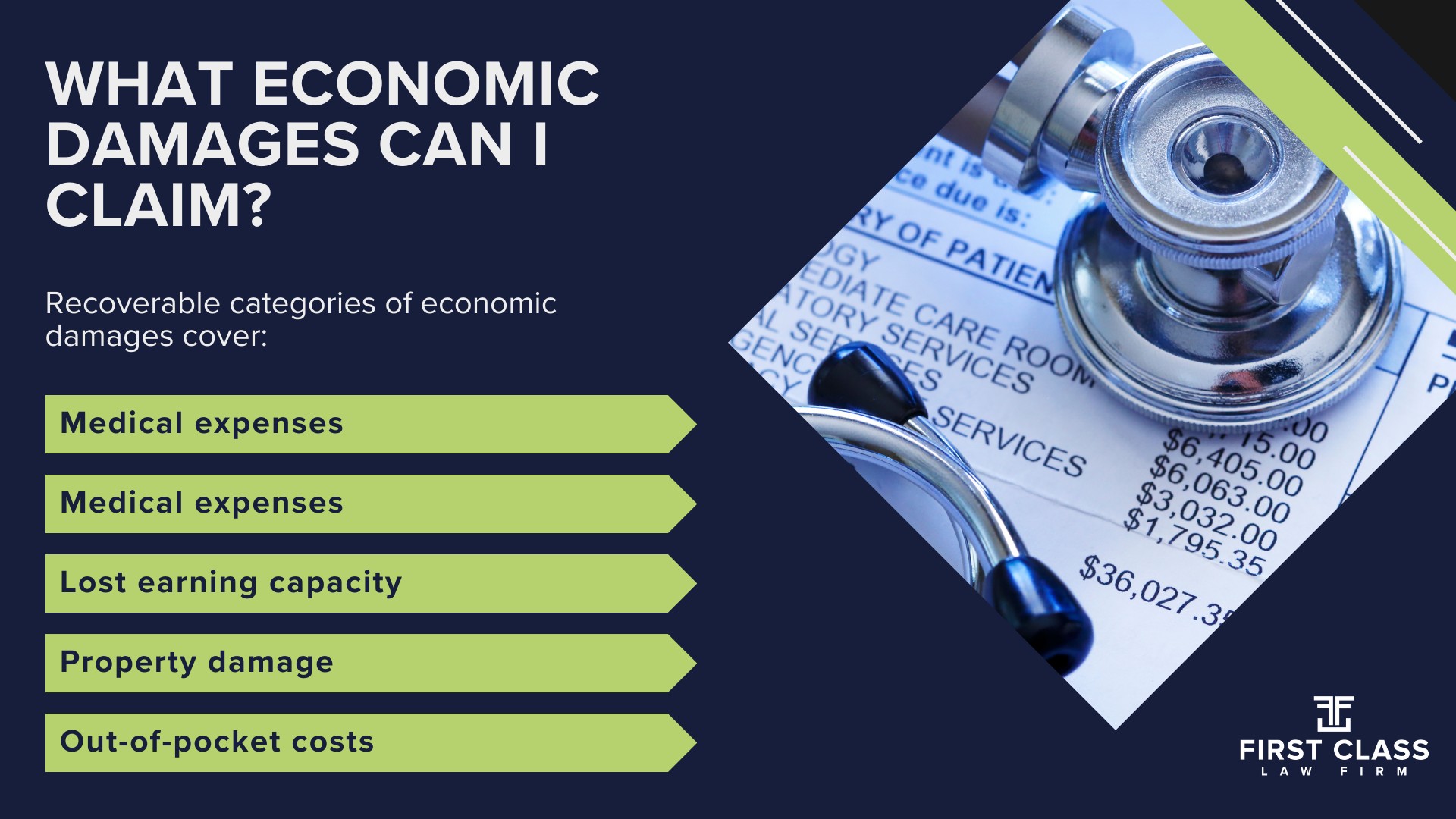
Recoverable categories of economic damages cover:
These damages require thorough documentation to prove their value.
Insurance companies frequently make lowball offers that don’t account for future medical expenses or long-term earning losses, making it vital to calculate both current and anticipated economic impacts before accepting any settlement.
Non-economic damages compensate you for emotional injuries and other harms that don’t come with price tags but affect your quality of life.
These damages acknowledge the human cost of your injuries beyond financial statements.
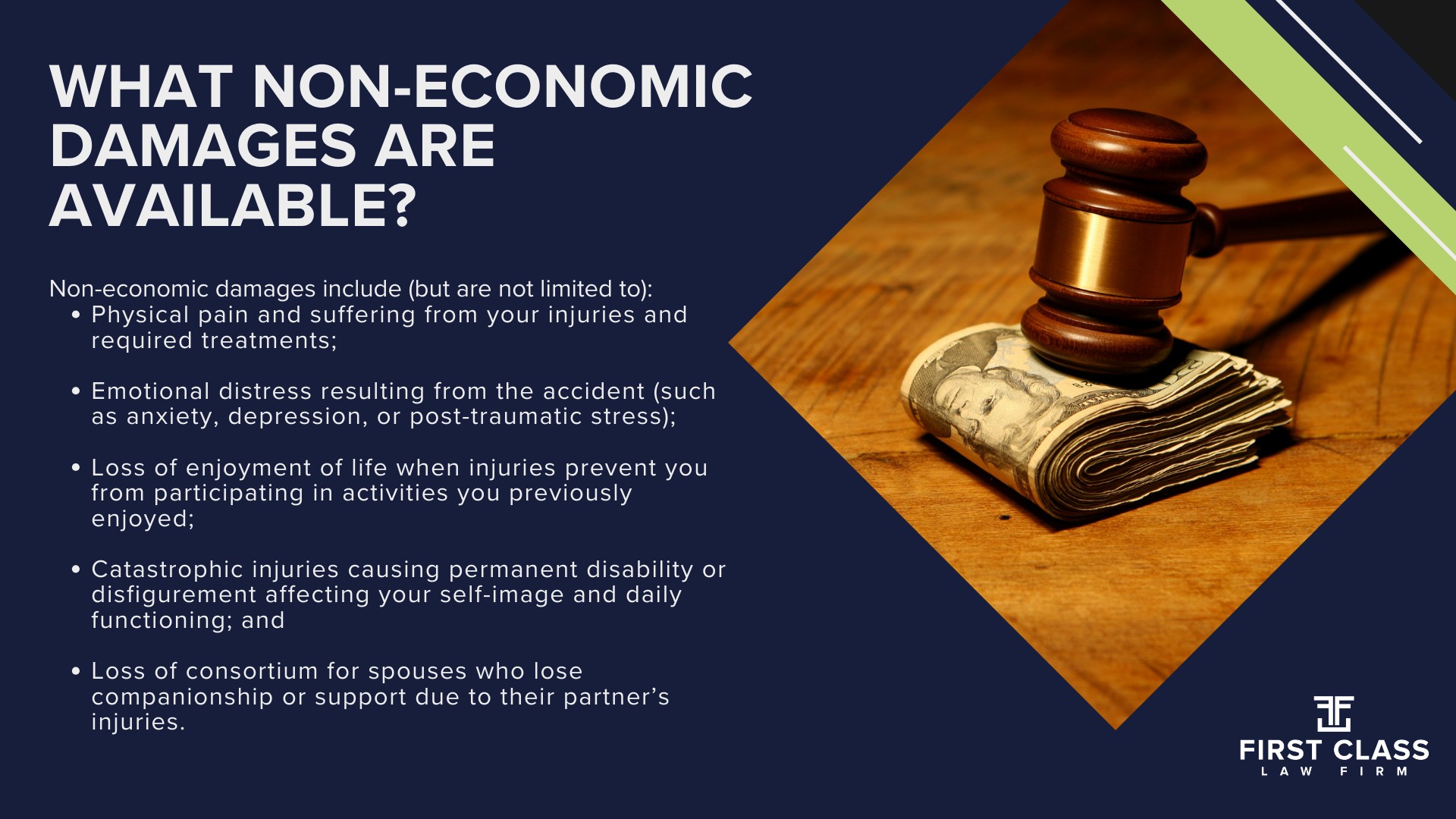
Non-economic damages include (but are not limited to):
Punitive damages serve a different purpose than compensatory damages by punishing defendants for especially harmful behavior and deterring others from similar conduct.
Courts may grant punitive damages when defendants acted with specific intent to cause harm, showed willful misconduct or conscious indifference to consequences, or engaged in gross negligence demonstrating reckless disregard for others’ safety.
These damages require clear and convincing evidence of culpable conduct beyond ordinary negligence.

If you or a loved one has suffered injuries due to someone else’s negligence, you may be eligible to seek compensation.
Contact First Class — The Atlanta Personal Injury Law Firm using the chat on this page to discuss what types of compensation apply to your case with an experienced personal injury attorney in Atlanta.
Cost concerns prevent many injury victims from seeking legal representation when they need it most.
When you’re already facing medical bills and lost income, the prospect of paying attorney fees can seem overwhelming.
Fee structures matter when selecting an attorney because they determine when and how you pay for legal services.
The Rules of Professional Conduct provide standards of ethical conduct for lawyers in Georgia, including regulations governing fee agreements.
Contingency fee arrangements allow injury victims to hire experienced legal representation without paying anything upfront.
This fee structure aligns your attorney’s financial interests with your own, as payment depends on securing compensation for your claim.
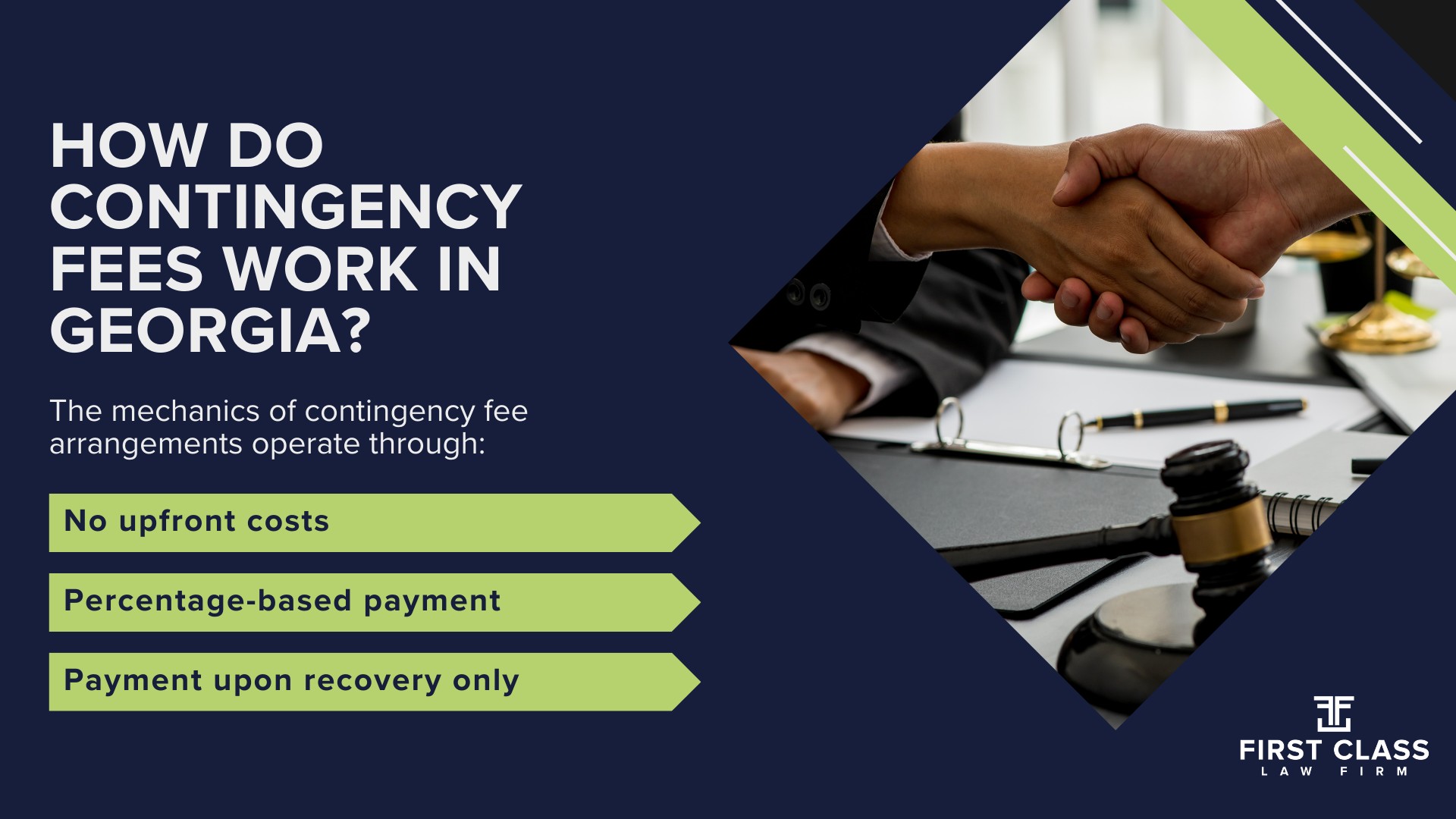
The mechanics of contingency fee arrangements operate through:
This arrangement benefits injury victims by removing financial barriers to quality legal representation.
You can pursue your claim without worrying about hourly billing or mounting legal expenses during your recovery.
Georgia State Bar Rules of Professional Conduct regulate contingency fee agreements to protect clients and ensure attorneys handle these arrangements ethically and transparently.
The “no win, no fee” promise sounds straightforward, but you should know exactly what this phrase covers before signing any agreement.
This arrangement protects you from paying attorney fees if your case doesn’t result in compensation, but other considerations apply.
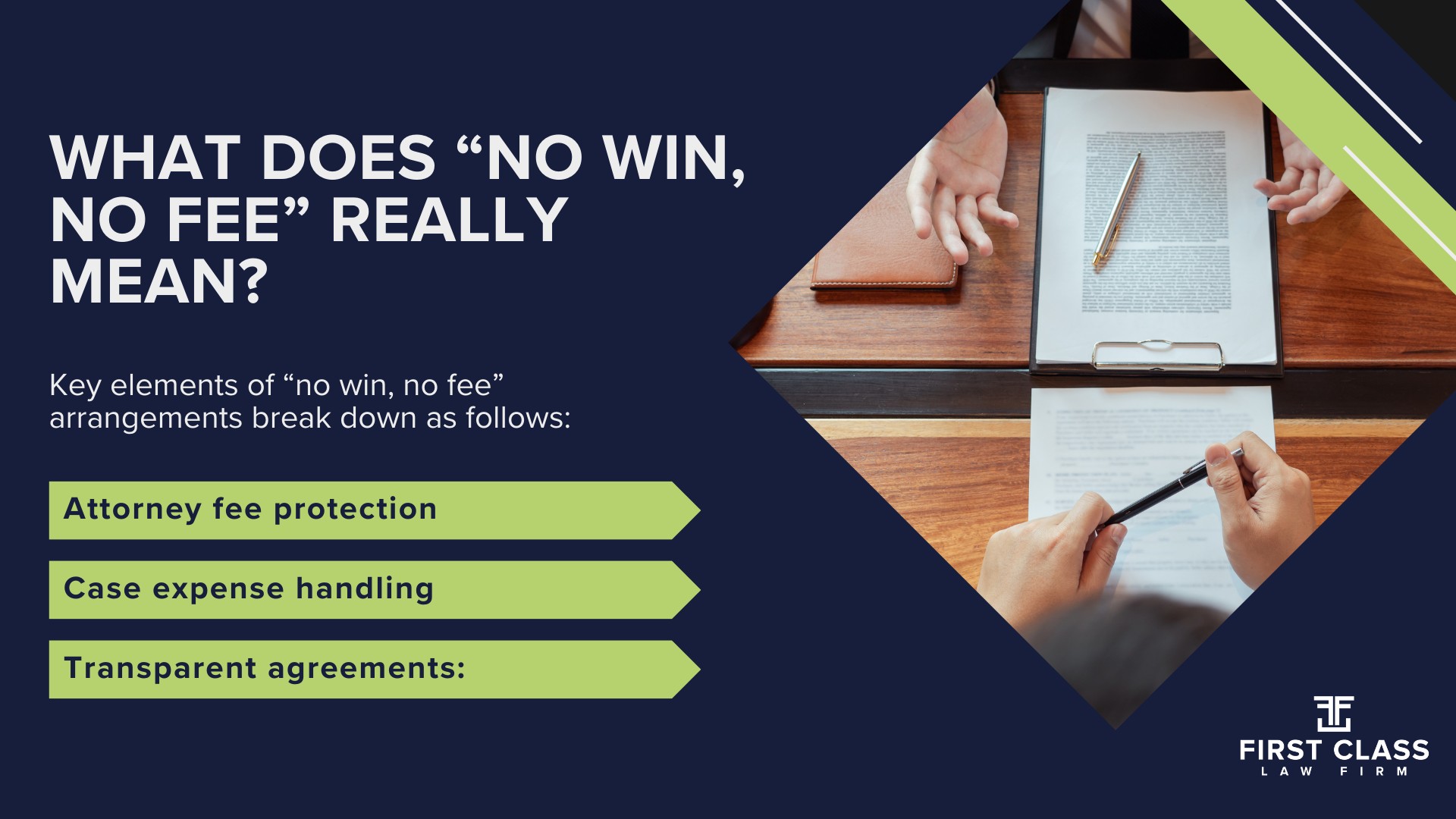
Key elements of “no win, no fee” arrangements break down as follows:
Questions to ask a personal injury attorney before hiring include clarifying how case expenses are handled and what happens if your case is unsuccessful.
If you or a loved one has been injured and needs legal representation, you may be eligible to seek compensation.
Contact First Class — The Atlanta Personal Injury Law Firm using the chat on this page to receive a clear explanation of fee structures and learn how an Atlanta personal injury attorney can help you pursue your claim.
Georgia law imposes strict deadlines for filing personal injury lawsuits, and missing these deadlines typically means losing your right to seek compensation regardless of how strong your case might be.
These time limits, called statutes of limitations, exist to ensure claims are filed while evidence remains fresh and witnesses’ memories are reliable.
Acting promptly after an injury protects your legal rights and gives your attorney time to build the strongest possible case.
The statute of limitations sets a firm deadline that controls when you must file your lawsuit.
For most personal injury cases in Georgia, you have two years from the date of injury to file a lawsuit in civil court.
Georgia Code Section 9-3-33 establishes this two-year window for personal injury claims, including vehicle accidents, slip and fall incidents, medical malpractice, and other negligence-based cases.
The clock for legal proceedings typically starts running on the date the injury occurred, not when you discovered the full extent of your damages or when treatment ended.
If you wait until after the two-year deadline passes, courts will almost certainly dismiss your case, leaving you without any legal recourse to recover compensation for a preventable accident regardless of how severely you were injured or how clear the defendant’s fault may be.
While the two-year statute of limitations applies to most personal injury cases, Georgia law recognizes certain exceptions that may extend or pause this deadline in specific circumstances.
The discovery rule may apply when injuries or their cause aren’t immediately apparent, potentially delaying when the statute of limitations begins.
Minors injured before age 18 generally have until their 20th birthday to file claims, though exceptions exist for medical malpractice cases.
Cases against government entities require ante litem notice under O.C.G.A. § 36-11-1, demanding written notice within six months for county claims or one year for municipal claims before filing suit.
Mental incapacity at the time of injury may toll the statute of limitations until capacity is restored.
These exceptions involve technical legal requirements that demand careful analysis.
If you or a loved one has been injured, time limits may affect your right to seek compensation.
Contact First Class — The Atlanta Personal Injury Law Firm using the chat on this page to determine the specific deadline that applies to your case and speak with a personal injury lawyer in Atlanta today.
Selecting the right attorney affects not only the outcome of your case but also your experience throughout the legal process.
The choices you make when hiring representation can determine whether you receive personalized attention or become just another file number in a high-volume practice.
Selecting a lawyer for your particular case requires evaluating credentials, communication style, case approach, and how the attorney’s practice model aligns with your needs.
When you’re recovering from injuries and facing financial pressure, you need an attorney who will prioritize your case and remain accessible throughout the process.
Specific qualities distinguish attorneys who provide excellent representation from those who simply process cases.
Before committing to any attorney, verify they possess the attributes that lead to favorable outcomes and positive client experiences.
Priority qualities to verify when evaluating attorneys are:
These qualities ensure your attorney has both the skills to handle your case effectively and the commitment to treat you as a priority throughout the process.
Practice size and case volume directly affect the attention your case receives and the relationship you’ll have with your attorney.
Client-centered practices and high-volume firms operate with fundamentally different priorities that impact your experience.
High-volume firms handle hundreds of cases simultaneously, often relying on paralegals and junior associates to manage client communication while senior attorneys focus on courtroom appearances.
This approach may work for straightforward cases but limits individualized attention.
Client-centered practices maintain manageable caseloads that allow attorneys to personally handle each case, develop tailored strategies based on specific circumstances, and build direct relationships with clients rather than delegating communication to support staff.
First Class takes a different approach to personal injury representation by prioritizing quality relationships over case quantity.
Nathan Whittenburg built this practice around the principle that injury victims deserve direct attorney access and individualized attention.
First Class operates as a virtual-first boutique practice, eliminating the need for injured clients to travel to an office while recovering.
Nathan personally handles all client communication through a secure online portal that provides real-time case updates, ensuring you always know your case status without waiting for callbacks.
The limited caseload model means your case receives focused attention rather than competing with hundreds of other files for attorney time.
Questions you should ask when evaluating attorneys include whether you’ll communicate directly with the lawyer handling your case and how many active cases they’re managing simultaneously.
Contact First Class using the chat on this page to experience the difference that client-centered representation makes when you’re pursuing compensation for your injuries.
Injuries create financial hardship, physical pain, and emotional stress that shouldn’t fall on your shoulders when someone else’s negligence caused your harm.
The Atlanta Personal Injury Law Firm is currently accepting clients for personal injury cases throughout Atlanta, GA.
A few reasons to choose Nathan Whittenburg and First Class for your personal injury case include:
If you or a loved one suffered injuries caused by someone else’s negligence, you may be eligible to seek compensation.
Contact the Atlanta Personal Injury Law Firm using the chat on this page to receive a free case evaluation and discuss your case with an Atlanta personal injury attorney who prioritizes your recovery and your rights.